
If you’re shopping for a home loan, you’ve probably noticed something: OCBC home loan rates don’t come in a neat “one size fits all” option. Instead, you’re greeted with fixed packages, floating packages, SORA-pegged options, spreads, lock-ins and a lot of small print. At some point, almost everyone asks the same question: “Which is actually better for the next 3 to 5 years – fixed or floating?”
The honest answer is: it depends less on which rate “wins” on paper and more on how each behaves over time, how much risk you can tolerate, and how likely you are to review and refinance. In this guide, we’ll walk through how fixed and floating OCBC home loans typically play out over 3–5 years, what to watch for beyond the headline number, and how to choose the structure that fits your life (and nerves), not just the bank’s brochure.
Fixed vs Floating: What Are You Really Choosing?
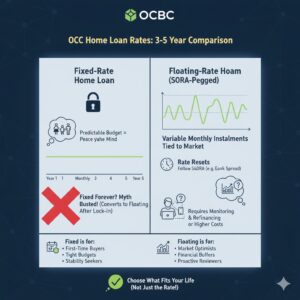
When you pick between fixed and floating OCBC home loan rates, you’re not just choosing a number – you’re choosing a pattern of how your mortgage behaves. A fixed-rate package gives you a stable interest rate for a set period, usually a few years. During that time, your monthly instalment is gloriously predictable, which makes budgeting much easier.
With a floating-rate package, your loan is usually pegged to a benchmark like compounded SORA plus a fixed spread. That means your interest rate (and therefore your instalment) can move up or down when the benchmark changes at each reset date. In good times, you enjoy lower payments. In less friendly times, you’ll see them creep up.
The big picture: fixed loans trade a bit of flexibility for stability, while floating loans trade stability for the chance of lower costs – and the risk of higher ones. Over 3–5 years, that trade-off becomes very real in your monthly cash flow.
How Fixed OCBC Home Loan Rates Behave Over 3 to 5 Years
A fixed-rate package is like subscribing to a “no plot twists” mortgage for a defined season of your life. For the fixed period – say 2, 3 or 5 years – your interest rate doesn’t change, no matter what the market does. If global rates jump, you’re shielded. If they fall, you don’t benefit, but you also don’t lose sleep.
From a 3–5 year perspective, fixed OCBC home loan rates work well if:
- You’re a first-time buyer who needs predictable cash flow.
- Your budget is tight and you can’t comfortably absorb big jumps in instalments.
- You simply don’t want your monthly payment to become a hobby you monitor every quarter.
The catch is what happens after the fixed period ends. Most fixed packages eventually revert to a floating structure, often at a “thereafter” rate that may not be the most competitive in the market. That’s why savvy borrowers treat the end of the fixed period as a built-in checkpoint: time to consider repricing with OCBC or refinancing to another bank.
Over a 3–5 year horizon, fixed packages shine when your fixed period covers most or all of that window, and you’re disciplined enough to review your options before the reversion kicks in.
How Floating OCBC Home Loan Rates Behave Over 3 to 5 Years
Floating-rate packages have one core promise: your rate will move with the market, for better or worse. Typically, these loans are pegged to a benchmark like 1M, 3M or 6M compounded SORA with a fixed spread added on. Your rate resets periodically (for example, every 3 months on a 3M SORA package), and your instalment can change accordingly.
Over 3–5 years, that means you’ll experience a series of mini-adjustments rather than one static rate. If interest rates trend down or stay relatively low, floating OCBC home loan rates can work out cheaper than fixed alternatives, especially if you’re comfortable riding out short-term bumps. You may also have more flexibility after the initial lock-in period to refinance or reprice, depending on your package.
However, if rates rise during your 3–5 year window, you’ll feel that in your monthly payments. The impact might be gradual, but on a large loan even a 0.5–1.0% change over a few resets can be significant. Floating loans reward you for being proactive: watching the environment, knowing your reset dates, and being ready to restructure if the numbers stop making sense.
Three Real-Life Lenses: How Each Option Feels in Practice
1. The Young Couple on a Tight Budget
If you’re buying your first home, juggling renovation costs and trying to build an emergency fund, stability often matters more than shaving every last decimal off your rate. Fixed OCBC home loan rates can be your financial shock absorber for the first 3–5 years while you get settled.
In this scenario, a 2–3 year fixed package can give you breathing room. You know exactly what you’ll pay, which helps you avoid cash flow surprises when you’re still adjusting to homeownership. Before the fixed period ends, you plan a review: compare repricing options with OCBC and see how floating packages look at that time.
Could a floating package be cheaper? Possibly. But if every unexpected increase would throw your budget out of balance, fixed might be the smarter long-term choice, even if it looks slightly pricier on day one. Peace of mind is also part of your “effective cost.”
2. The Upgrader Planning Ahead
If you’re upgrading from an HDB to a condo and already know you might move again in a few years, your horizon is very clearly 3–5 years. In this case, the “best” structure is the one that balances reasonable rates with flexible exit options.
You might choose a shorter fixed period that aligns with your expected timeline, or a competitive floating package with a lock-in that doesn’t trap you beyond when you intend to sell. Here, you’re not trying to predict every rate movement. Instead, you’re matching your loan structure to your property plans and making sure potential penalties and clawbacks don’t ambush you when you execute your exit.
3. The Investor With Multiple Properties
Investors often look at OCBC home loan rates through a portfolio lens rather than a single-property lens. For them, floating packages can look attractive across 3–5 years if they believe rates will stabilise or drift lower – and if they have the cash flow and buffers to handle volatility.
In this case, a SORA-pegged floating package with a reasonable spread and a sensible lock-in may offer more value. The investor may also stagger fixed and floating loans across different properties to avoid all loans resetting at the same time. Here, the decision is less about nerves and more about risk management and strategic flexibility.
Key Things to Compare Beyond the Headline Rate
When you’re comparing fixed and floating OCBC home loan rates over 3–5 years, don’t stop at the headline numbers. Look at how the whole package behaves over time. Important items include:
- Lock-in period: How long are you tied in, and what penalties apply for selling or refinancing early?
- Reversionary rate: What happens after the fixed period ends? What formula will your rate follow?
- Spread over SORA (for floating loans): Is the spread stable, and are there any steps where it increases after a few years?
- Prepayment rules: Can you make partial prepayments without penalty? How much flexibility do you have to reduce principal?
- Subsidies and clawbacks: Are there legal or valuation subsidies, and will you have to repay them if you leave within a set timeframe?
When you put all of this into a simple 3–5 year projection – even a rough one – you often see that the “cheapest” package on the surface isn’t always the cheapest once penalties, reversion rates and flexibility are factored in.
Common Mistakes People Make When Choosing Between Fixed and Floating
One classic mistake is assuming that floating automatically means “better, because it starts lower.” That’s only true if you can handle potential increases and if you’re prepared to review and act when conditions change. If you’re the type to ignore your loan until something hurts, a floating package can quietly become expensive.
Another mistake is forgetting that your life plans matter just as much as interest rate forecasts. If you might have kids, change jobs, start a business or move overseas within 3–5 years, your need for stability or flexibility may be very different from someone settling into a “forever home.” Choosing purely based on today’s rate without thinking about tomorrow’s reality is an easy way to regret a “clever” decision.
Finally, some people only speak to one bank or one person and assume that’s the whole story. Even when you’re focused specifically on OCBC home loan rates, it’s worth understanding how they stack up against the broader market and how different OCBC packages compare internally. A quick sense-check can stop you from locking into a structure that doesn’t really suit your profile.
How to Decide: A Simple Framework for Normal Humans
If you don’t want to drown in scenarios, use this simple framework:
- Define your horizon: Are you likely to keep this property (and loan) for at least 3–5 years, or is it a shorter stop?
- Assess your risk tolerance: On a scale from “I sleep fine” to “I obsess over every bill”, how would you feel about instalments that move every few months?
- Stress-test your budget: Could you still cope if your floating rate rose by 0.5–1.0% within the next few years?
- Match structure to personality:
- If you’re risk-averse, budget is tight, and your horizon is clear → lean towards fixed for that period.
- If you’re flexible, have buffers, and don’t mind monitoring rates → consider floating, especially if you intend to review regularly.
From there, compare a fixed and a floating OCBC package over a 3–5 year period including fees, not just rates. If one is clearly cheaper and fits your risk profile, your answer usually reveals itself.
Final Thoughts: It’s About Fit, Not Just Forecasts
At the end of the day, the question isn’t “Are fixed or floating OCBC home loan rates better?” The real question is, “Which structure fits the next 3–5 years of my life best?” Fixed loans gift you stability when you need it most. Floating loans reward you for flexibility, attention and risk tolerance. Both can be good choices – just for different people and different seasons.
If you treat your mortgage as something to be reviewed at key milestones rather than a once-in-a-lifetime decision, you don’t need to get everything perfect on day one. Choose a structure that you can live with comfortably, keep an eye on how the market and your life evolve, and be ready to refinance or reprice when it makes sense. That’s how you make OCBC home loan rates work for you, not the other way around.
