
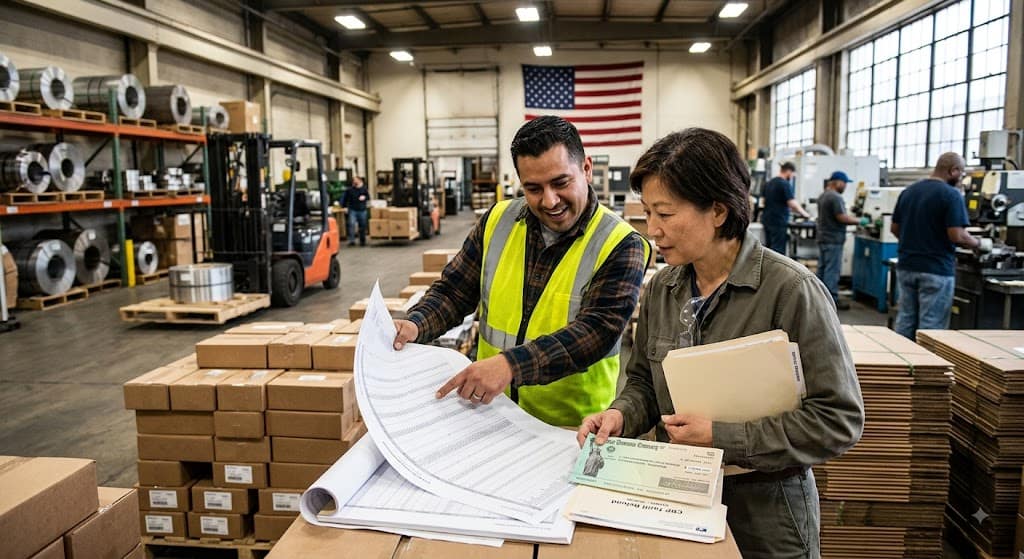
The US government is sending billions of dollars back to importers after the Supreme Court struck down a major part of the Trump administration’s tariff program. Around $100 billion in refunds have already been approved for payment, turning a legal ruling into a major cash-flow event for US businesses. But the impact goes much further. The refunds could affect company profits, consumer prices, federal revenue, and the next phase of US trade policy.
What Are the US Tariff Refunds?
The refunds cover duties collected under tariffs that were imposed using the International Emergency Economic Powers Act, or IEEPA. After the US Supreme Court ruled that IEEPA did not give the president authority to impose those tariffs, affected importers became eligible to recover the money they had paid.
As of July 31, importers submitted 252,496 refund claims. Around $128.68 billion had been accepted for processing, while roughly $100 billion in duties and interest had already been certified by US Customs and Border Protection and forwarded to the Treasury for payment.
| Item | Amount / Figure |
| IEEPA tariffs collected | Around $166 billion |
| Refund claims submitted | 252,496 |
| Refunds accepted for processing | $128.68 billion |
| Refunds certified for payment | Around $100 billion |
The refunds are paid to eligible importers of record and can also include interest. However, not every tariff imposed during the Trump administration is affected. Duties introduced under other trade laws remain separate from this refund process.
Why Did the Supreme Court Strike Down Tariffs?
The dispute centered on the law used to impose tariffs. The Trump administration relied on the International Emergency Economic Powers Act, or IEEPA, to introduce broad tariffs in 2025. The law gives presidents wide powers during national emergencies, but it does not specifically grant authority to impose tariffs.
On February 20, 2026, the Supreme Court ruled 6-3 that IEEPA could not be used for this purpose. The decision did not ban presidential tariffs altogether. Instead, it found that this law was not a valid legal basis for collecting them.
Other tariff powers remain available under laws such as Section 232 of the Trade Expansion Act and Sections 122 and 301 of the Trade Act. This is why the ruling removed the IEEPA tariffs without ending US tariff policy.
Who Actually Receives the Refunds?
The refunds generally go to the importer of record. This is the company or entity that officially brought the goods into the US and paid the tariff to Customs. Retailers, distributors, or end customers do not automatically receive a share unless they were also the importer of record.
This creates an important gap between who paid the tariff legally and who carried the cost economically. Many importers passed part of the extra cost on through higher prices, while others absorbed it through lower margins.
For example, a company imports a product worth $1,000 and pays a $100 tariff. It raises the selling price enough to recover $70 and absorbs the remaining $30. If the full $100 tariff is later refunded, there is no automatic rule requiring the company to return the $70 to customers who already paid the higher price.
That means the refunds can improve company cash flow and margins without fully reversing the earlier impact on consumers.
What Do $100 Billion in Refunds Mean for US Companies?
For affected companies, the refunds can provide a major boost to cash flow. Businesses that previously paid millions in tariffs may now recover those costs along with interest. This can free up money for inventory, investment, debt repayment, or other operating needs.
The impact on profits depends on how companies handled the original tariff cost. Firms that absorbed most of the tariffs through lower margins may recover a larger part of that pressure. Companies that passed the cost on to customers could see an even stronger financial benefit if selling prices remain unchanged after the refund.
Refunds Can Temporarily Boost Earnings
Tariff refunds can also create one-time gains in company results. A business may record recovered tariff expenses as a benefit, making quarterly earnings look stronger than normal.
For investors, this makes it important to separate refund-related gains from regular operating performance. A sharp rise in profit caused by a tariff recovery does not necessarily mean the underlying business is growing at the same pace.
What Do Refunds Mean for Inflation?
The refunds may ease some inflation pressure, but the effect is unlikely to be immediate. Tariffs raised import costs, and many businesses responded by increasing prices. Federal Reserve research estimated that tariffs introduced through November 2025 had lifted core goods prices by about 3.1% by February 2026.
Removing those tariffs lowers the cost pressure on affected imports going forward. Still, a refund does not automatically reverse price increases that already happened. Companies may use the money to rebuild margins instead of cutting prices, especially if they previously absorbed part of the tariff themselves.
The bigger question is what replaces the cancelled tariffs. The US has already introduced new duties under other trade laws. If those remain in place, part of the inflation pressure could continue even as billions in old tariffs are refunded.
How Did Markets React to the Tariff Ruling?
Markets initially welcomed the Supreme Court decision. On February 20, the S&P 500 rose 0.69%, while the Nasdaq gained 0.90%. European stocks also moved higher as investors priced in lower tariff costs and potential refunds for large importers.
The reaction was especially positive for companies that rely heavily on imported goods, since the ruling improved the outlook for margins and cash flow. However, the bond market was less straightforward. Treasury yields moved higher as investors considered the fiscal cost of refunding billions in previously collected tariff revenue.
For markets today, the bigger impact is likely to be company-specific. Investors are watching which firms receive large refunds, how those gains affect earnings, and whether new tariffs offset the benefit.
What Could Happen Next?
The refund process is still developing, while the US continues to rebuild its tariff policy under different legal authorities. For businesses and markets, the next phase will depend on whether those replacement tariffs survive legal challenges and how broadly they are applied.
| Scenario | Possible Outcome |
| New tariffs survive legal challenges | Import costs remain elevated, while the current refunds become mainly a one-time benefit for affected companies. |
| Courts restrict replacement tariffs | Import costs could fall further, easing pressure on company margins and consumer prices. |
| Tariff rules keep changing | Businesses may continue facing uncertainty over sourcing, pricing, investment, and future trade costs. |
For investors, this means the $100 billion refund story is not the end of the tariff issue. The focus now shifts to new court cases, replacement duties, inflation data, and how companies use the cash they receive.
FAQ
Do companies have to return tariff refunds to customers?
Generally, no. The refund goes to the eligible importer, and there is no automatic federal requirement to pass it back to customers who previously paid higher prices. Specific contracts or other legal obligations could create exceptions.
Are tariff refunds taxable income for companies?
It depends on how the original tariff cost was treated for tax purposes. If a company previously deducted the expense and received a tax benefit, the recovered amount may need to be included in income under the tax benefit rule. Interest received with the refund is generally taxable.
Why do tariff refunds include interest?
US customs law requires CBP to calculate interest on qualifying duty refunds. This compensates importers for the period during which the government held the money.
Can a company receive a refund if it was not the importer of record?
Generally, not directly through the CAPE process. A declaration must be filed by the importer of record or an authorized customs broker acting on its behalf.
Could the government eventually refund more than $166 billion?
The amount of duties refunded should be tied to eligible tariffs that were collected. However, the government’s total payout can exceed the refunded principal because qualifying payments also include interest.
